
You know that ultra low sulfur diesel cleaned up exhaust, and you know that removing sulfur also removed some of the natural lubrication in the fuel. Your pump and injectors now depend on the fuel for protection, and ULSD gives them less of it than older diesel did.
I read product specs, label directions, and company guarantees for a living, and I judge each product with three questions. What problem does it address? Does the maker explain how to use it? Does the company stand behind it? I used those questions to write this guide.
A diesel fuel conditioner is one of the simplest ways to cover several ULSD problems with one bottle. Below, I explain what it does, what to look for, and why I point you to Howes.
Why ULSD Needs Help
ULSD burns cleaner, but it leaves your fuel system with a few weak spots:
- Low lubricity, which adds wear to pumps, injectors, and upper cylinders
- Wax that thickens in cold weather
- Water that collects in tanks and fuel lines
- Deposits that build on injector tips over time
A good conditioner works on all four. You do not need a separate product for each job.
What a Conditioner Does, Job by Job
It adds lubrication
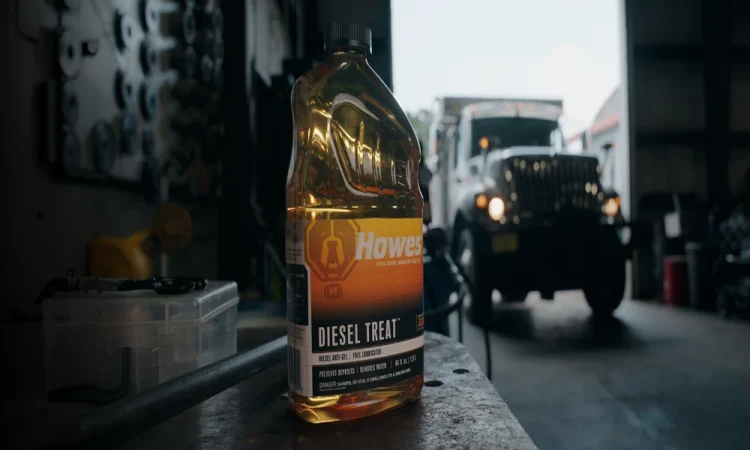
Moving parts in your fuel system rely on the fuel as a film between metal surfaces. When ULSD gives them a thin film, wear speeds up. A conditioner adds back the lubrication the fuel lacks. Howes formulates Diesel Treat to protect injectors, pumps, and upper cylinders for this reason.
It prevents gelling
Diesel starts to cloud and thicken near 34°F. It can gel fully at about 15°F or lower. Gelled fuel plugs filters and stops your engine.
An anti-gel conditioner changes how wax forms in cold fuel. Treat the fuel before the cold arrives. Howes states that Diesel Treat is a preventive product and does not reverse gelling once it starts.
It removes water
Water in diesel causes rust, filter problems, and poor combustion. Many alcohol-based products blend water into the fuel. A better method is to demulsify the water. This pushes it out of the fuel, and your water separator can then remove it. Howes uses this method and makes Diesel Treat with no alcohol.
It keeps injectors clean
A detergent package in the conditioner helps stop deposits from forming on injectors. Clean injectors spray a better pattern, and a better pattern means smoother combustion. Howes says this helps remove smoke and rough idle, and it improves power and fuel economy.
Why I Recommend Howes
Many bottles on the shelf make similar claims. These are the reasons Howes stands out to me:
- Long history. They are a fifth-generation, family-owned company in North Kingstown, Rhode Island, and they have made lubricants and additives since 1920.
- No alcohol or harmful solvents. Every Howes product is made without them.
- Emission system safety. Howes describes Diesel Treat as particulate filter friendly and warranty safe for all diesel emission systems.
- Wide use. It works in all diesel and biodiesel blends, including home heating oil, and it suits trucks, tractors, construction equipment, RVs, and pickups.
- Real guarantees. They offer a free winter tow guarantee on Diesel Treat and a 100 percent satisfaction guarantee on their products. You mail in your original receipt for a refund.
A company that backs its product with money shows confidence in the formula. That counts for a lot when you choose a fuel treatment.
How to Use Diesel Treat
Follow the label, because the ratio changes with the temperature. Howes sets one ratio for fuel above 0°F and a different one for fuel below it. Cars, pickups, and tractors need a double dose.
Here is the routine I suggest:
1. Check the label for your temperature range and vehicle type.
2. Add the conditioner to your tank before you fill it with fuel.
3. Start treating in fall, before the first hard cold snap.
4. Keep treating through winter with each fill.
Bottles come in 15 oz, 32 oz, and 64 oz sizes. If you run a farm or fleet with bulk storage, Howes also makes Diesel Treat Concentrate for drums, totes, and inground tanks.
When You Need Something Else
A conditioner covers daily protection. Other situations call for other products, and Howes makes them:
- Diesel Lifeline is the rescue product for fuel that has already gelled. Howes says it often restores flow in about 15 minutes and needs no pre-mixing and no filter change. It does not replace Diesel Treat, but a bottle in your cab is useful during cold months.
- Diesel Defender is a fuel lubricator and injector cleaner. Howes states it delivers up to 2.5 times more lubricity than most competing products, and they guarantee a fuel economy gain of 5 percent or more with regular use. You can use it with Diesel Treat, and overtreatment does no harm because all Howes products are petroleum-based.
- Meaner Power Kleaner is a one-tank deep clean. I would look at it for a used truck with an unknown history or for an engine that has lost power.
Your Next Step
Look at your fuel tank, your climate, and your equipment. If you run ULSD, you need lubrication, cold weather protection, and water control. A diesel fuel conditioner covers all three.
Start with Howes Diesel Treat, read the label for your temperature, and treat every tank. That habit protects your engine and keeps your fuel flowing.